---
title: Why is there HEX amplification in my Aspergillus Multiplex Control reaction?
description: qPCR crosstalk in positive controls
---
[Skip to content](https://help.medicinalgenomics.com/en/late-#main-content)
[](https://medicinalgenomics.com)
- [Help Center](https://help.medicinalgenomics.com)
- [Web Store](https://store.medicinalgenomics.com)
Open main navigation
Close main navigation
- [Help Center](https://help.medicinalgenomics.com)
- [Web Store](https://store.medicinalgenomics.com)
- [Contact us](mailto:support@medicinalgenomics.com)
[Contact us](mailto:support@medicinalgenomics.com)
How can we help you?
- There are no suggestions because the search field is empty.
1. [Help Center](https://help.medicinalgenomics.com/en?hsLang=en)
2. [Microbial Safety Testing](https://help.medicinalgenomics.com/en/microbial-safety-testing?hsLang=en)
3. [Aspergillus](https://help.medicinalgenomics.com/en/microbial-safety-testing?hsLang=en#aspergillus)
# Why is there HEX amplification in my Aspergillus Multiplex Control reaction?
## If a HEX amplification curve is observed in the positive control well while all No-Template Controls (NTCs) are deemed acceptable, the run should be considered valid. On some qPCR instruments, a strong FAM signal can produce a low-level HEX signal due to optical crosstalk (spectral bleed-through) between detection channels. Although the HEX fluorescence is typically weak (low RFU), it may still cross the analysis threshold and be assigned a Cq value by the instrument software. This low-level HEX signal is an optical artifact and does not represent true target amplification, contamination, or assay failure. The absence of amplification in the NTCs confirms that the reagents are free of contamination. Therefore, no rerun is required, and the results may be interpreted as normal.
### Use your no-template controls (NTCs) as the referee
**✅ Run is valid:** If all **No-Template Controls (NTCs)** remain negative (no amplification in the FAM channel and a Cq \> 35 on the HEX channel), a low-level HEX signal observed only in wells containing a strong FAM-positive amplification is consistent with **optical crosstalk (spectral bleed-through)**. On some qPCR instruments, this weak HEX fluorescence may cross the analysis threshold and be assigned a Cq value despite not representing true amplification. This is an expected optical artifact and does **not** affect assay performance. The run may be accepted, and results reported as normal.
**⚠️ Investigate before reporting:** If a HEX amplification signal is observed in an **NTC** or in any well that is **FAM-negative**, the signal should **not** be attributed to optical crosstalk. Because crosstalk occurs only in the presence of a strong FAM signal within the same well, HEX amplification in FAM-negative wells may indicate contamination, reagent issues, or an assay setup error. In these cases, follow your laboratory's established investigation and repeat-testing procedures before reporting results.
### Why This Happens
In multiplex qPCR assays, wells containing a **strong FAM-positive amplification** may occasionally display a weak signal in the **HEX** channel. This occurs because the intense FAM fluorescence can partially overlap the HEX detection window on some qPCR instruments, resulting in **spectral crosstalk (optical bleed-through)**.
Although the HEX fluorescence is typically low (low RFU), it may still cross the analysis threshold and be assigned a Cq value by the instrument software. This does **not** represent true HEX target amplification.
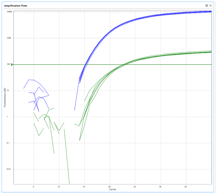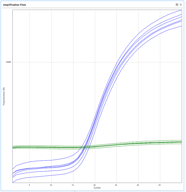
A distinguishing characteristic of spectral crosstalk is that the weak HEX signal occurs **only in wells with strong FAM amplification**, and its intensity correlates with the strength of the FAM signal. When No-Template Controls (NTCs) remain negative, this is an expected optical artifact of multiplex qPCR and should not be interpreted as contamination or assay failure.
### Real-Time (qPCR) Instruments will handle cross-talk in different ways
Depending on what instrument you use - you may not ever see this issue. The platforms that MGC has most commonly used behave as follows:
- The Bio-Rad platforms (CFX and Opus CFX) have software that detects and ignores crosstalk by default.
- The Agilent AriaMx software requires a cross-talk setting to be turned on to properly ignore crosstalk signal.
- The Bio Molecular System Mic workbench software requires a decision tree in the data analysis program to be setup to ignore crosstalk.
### User Guide Updates
We are updating the Aria MX data-analysis section of the product User Guide to describe this crosstalk behavior and the crosstalk correction guidance described above, so the expectation is documented alongside your workflow. This article will be kept in sync with those changes.
#### **Further reading on spectral crosstalk in multiplex qPCR**
- LGC Biosearch Technologies — Multiplexing qPCR (crosstalk / bleed-through between channels): https://oligos.biosearchtech.com/support/education/multiplex-qpcr
- LGC Biosearch Technologies — 8 qPCR amplification plot questions answered (FAM brightness; setting your own threshold): https://blog.biosearchtech.com/8-qpcr-amplification-plot-questions-answered
- Sigma-Aldrich — RT-PCR / qPCR troubleshooting (HEX is an inherently weaker dye than FAM): https://www.sigmaaldrich.com/US/en/technical-documents/technical-article/genomics/pcr/troubleshooting
- [Frequently Asked Questions](https://help.medicinalgenomics.com/en/frequently-asked-questions?hsLang=en)
- [Product Updates](https://help.medicinalgenomics.com/en/product-updates?hsLang=en)
- [Sample Purification](https://help.medicinalgenomics.com/en/sample-purification?hsLang=en#main-content)
- [Grim Reefer Free DNA Removal](https://help.medicinalgenomics.com/en/sample-purification?hsLang=en#grim-reefer-free-dna-removal)
- [Internal Control](https://help.medicinalgenomics.com/en/sample-purification?hsLang=en#internal-control)
- [AOAC](https://help.medicinalgenomics.com/en/sample-purification?hsLang=en#aoac)
- [Early Detection Plant Screening](https://help.medicinalgenomics.com/en/early-detection-plant-screening?hsLang=en#main-content)
- [FemINDICAtor® Plant Gender Testing](https://help.medicinalgenomics.com/en/early-detection-plant-screening?hsLang=en#femindicator-plant-gender-testing)
- [PathoSEEK® Plant Pathogen Testing](https://help.medicinalgenomics.com/en/early-detection-plant-screening?hsLang=en#pathoseek-plant-pathogen-testing)
- [Virus Assays](https://help.medicinalgenomics.com/en/early-detection-plant-screening?hsLang=en#virus-assays)
- [Genomic Services](https://help.medicinalgenomics.com/en/genomic-services?hsLang=en#main-content)
- [StrainSEEK®](https://help.medicinalgenomics.com/en/genomic-services?hsLang=en#strainseek)
- [Kannapedia](https://help.medicinalgenomics.com/en/genomic-services?hsLang=en#kannapedia)
- [Microbial Safety Testing](https://help.medicinalgenomics.com/en/microbial-safety-testing?hsLang=en#main-content)
- [Hardware and Consumables](https://help.medicinalgenomics.com/en/microbial-safety-testing?hsLang=en#hardware-and-consumables)
- [Validation](https://help.medicinalgenomics.com/en/microbial-safety-testing?hsLang=en#validation)
- [PathoSEEK](https://help.medicinalgenomics.com/en/microbial-safety-testing?hsLang=en#pathoseek)
- [Aspergillus](https://help.medicinalgenomics.com/en/microbial-safety-testing?hsLang=en#aspergillus)
- [Mic qPCR Instrument](https://help.medicinalgenomics.com/en/mic-qpcr-instrument?hsLang=en)
- [AriaMx](https://help.medicinalgenomics.com/en/ariamx?hsLang=en)
- [Automation](https://help.medicinalgenomics.com/en/automation?hsLang=en)
- [Product Specifications](https://help.medicinalgenomics.com/en/product-specifications?hsLang=en)
- [Contact Support](mailto:support@medicinalgenomics.com)
- [Sign Up for Our Newsletter](https://share.hsforms.com/1rFnAme5nTYuGeU0IdkMQGA20xr2)
- [Join Us at CannMed 26](https://cannmedevents.com)
[](http://www.medicinalgenomics.com)
Medicinal Genomics Help Center
Copyright © 2026, Medicinal Genomics